Coral Chimeras: A Study on Resilience
Published at: February 11th, 2026 by Mary DeasyA newly released study, led by our Mexico-based Sandra Mendoza-Quiroz, indicates that coral chimerism can be used for improving coral restoration efforts.
Chimeras are not just found in mythological tales of a creature with a lion's head and a serpent's body; they are found across nature and even in corals.
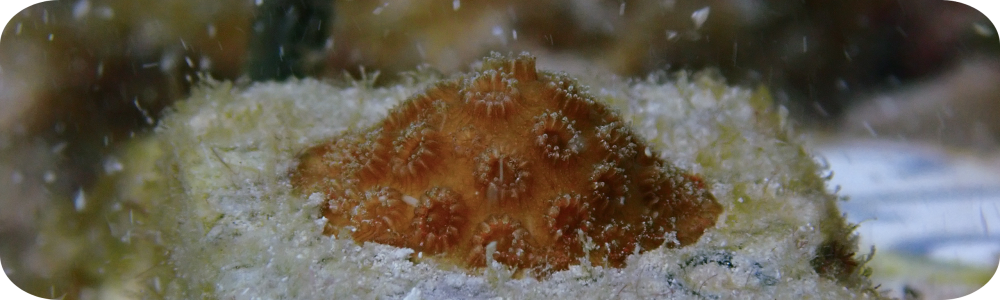
Coral chimeras are typically formed by the fusion of two or more genetically distinct juvenile corals of the same species. When young corals grow too close to each other, they compete for space. But sometimes, instead of fighting, they fuse. That fusion creates a chimera.
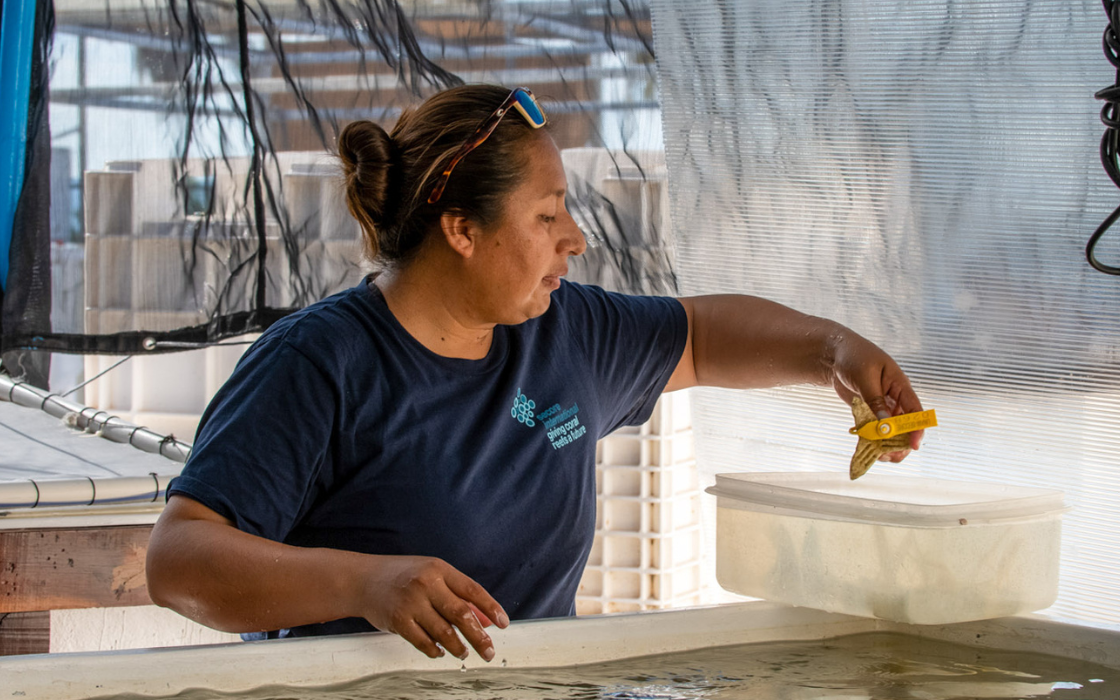
Our Mexico team, under the leadership of Sandra Mendoza-Quiroz and with the support of Coralium Lab, submitted a peer-reviewed scientific report on this phenomenon entitled, “Chimerism as a strategy to improve the resilience of boulder corals”. The co-authors looked at the formation and development of chimeric corals. They compared their growth and survival with nonchimeric corals of the same boulder coral species, including under high-stress conditions such as the severe coral bleaching of 2023.
A Study on Boulder Coral Chimeras
Phase 1: Development
For the first six months, our team tracked fusion success. They paired two juvenile corals by the same age and species, focusing on 6‑month‑old and 18‑month‑old Orbicella annularis and Orbicella faveolata, the star and mountainous boulder coral. Previous studies have found 4-months to be the age threshold for fusion. This phase re-evaluated whether successful fusion could still occur beyond that point.
Phase 2: Growth and Survival
It is known that coral fusion increases coral size, resulting in improved survivorship; however, is this correlation simply to do with size? To answer this question, Sandra and her team incorporated different sized ‘controls’ (i.e.nonchimeric corals) into the study in an attempt to account for the effect of size on growth and survival. The fused corals were outplanted on the reef alongside large and small non-chimeric Orbicella annularis and Orbicella faveolata corals from the same age cohort. For two years, they were monitored.
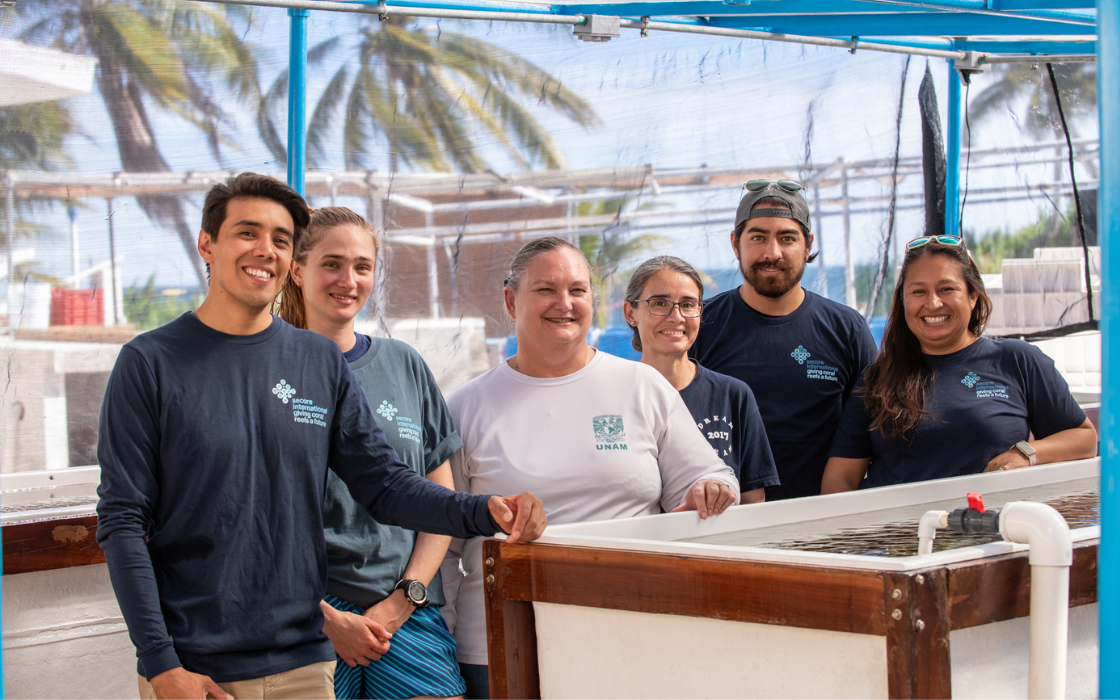
Our Mexico-based Restoration Coordinator, Sandra Mendoza-Quiroz
“Everything was going very well until the summer of 2023, when a heat wave critically affected the region for several months. For a moment, we thought that all our plantings had been lost, as thousands of adult corals had bleached and were beginning to die.
We continued to monitor them for a while, then found that the chimeras were doing well on the reef, even though we did not plant many. ” says Sandra Mendoza-Quiroz, our Restoration Coordinator in Mexico. This provided a unique opportunity to evaluate the long-term resilience of chimeras vs. non-chimeric O. annularis and O. faveolata during a high-stress event.
The Findings
Colony fusion is possible for both species up to 18-months. “In the case of O. faveolata, the success of fusion was dependent on age, with higher fusion success in younger colonies. In the case of O. annularis, the success of the fusion was very similar for both ages.” says Sandra Mendoza-Quiroz.
After outplanting, the chimeras showed 43–57% mortality in the first year but that drastically changed in the second year, 2023. It was in that year the record-breaking heat wave triggered mass bleaching across the Caribbean. Growth rates dropped for both nonchimeric size groups but surprisingly, no chimeras of either species experienced mortality during the heat wave; their naturally variable growth rates also didn't change.
Despite the high first‑year mortality, both chimera species ultimately showed higher survival than the non‑chimeric controls. Most notably, the O. faveolata chimeras had a remarkable twelve‑fold increase in survival over their two years on the reef.
 Sandra Mendoza-Quiroz
Impact for Coral Restoration
Warming ocean temperatures around the world are placing corals under immense pressure. In Mexico, “the situation is dire on the reefs, with a large loss of colonies from hurricanes, diseases, the 2023-2024 bleaching event and low water quality especially from Sargassum blooms.” Says Dr. Anastazia Banaszak, head of the Coralium laboratory, our long-term partner on site in Puerto Morelos, Mexico.
“It gives us hope that corals that have been bred at the UNAM lab and outplanted on the reef have shown higher survival despite all stressors.” These corals were bred using our Coral Seeding approach. By taking advantage of the natural reproduction potential of corals, Coral Seeding promotes genetic diversity, enabling the bred corals to better adapt to changing environmental conditions. There are opportunities to incorporate interventional breeding into our method that could further strengthen coral resilience. One option is to use chimeras.
The results from this study show that chimeras display increased stress resilience and can be a means of strengthening coral restoration efforts in the face of rapidly warming oceans. Integrating chimeras into restoration strategies could enhance long‑term success, and our Coral Seeding method makes this option feasible.
Read the full research paper in Nature’s Scientific Reports journal—“Chimerism as a strategy to improve the resilience of boulder corals”.
Co-authors & Supporters
A shoutout to our Mexico team including Raúl Tecalco Rentería, our Restoration Technician, under the leadership of Sandra Mendoza-Quiroz and with the support of Coralium Lab led by Anastazia Banaszak, (National Autonomous University of Mexico) and our very own Margaret Miller for their contribution to this study.